Directed by Lukas Feigelfeld
9.5/10
2/10
7.5/10
9.5/10
10/10
9.5/10
Into the Witching Wood: Folk Horror as Primordial Nightmare
Lukas Feigelfeld's Hagazussa emerges from the Austrian Alps like some ancient curse made manifest, a film that doesn't simply tell a story about witchcraft but seems to channel the very essence of pre-Christian terror that lurks in Europe's darkest forests. This is folk horror at its most uncompromising and visionary, a work that abandons conventional narrative structure in favor of something more primal and unsettling—a descent into madness that feels less like cinema and more like participating in some forbidden ritual that should have remained buried in the medieval past.
The film operates as a triptych of escalating psychological breakdown, following Albrun from traumatized child to isolated woman to something far more dangerous and unknowable. Feigelfeld's approach to storytelling is deliberately anti-narrative, structured more like a fever dream or folk ballad than traditional cinema. The sparse dialogue and extended atmospheric sequences create a hypnotic rhythm that draws viewers into Albrun's fractured psychological state, making us complicit in her gradual transformation from victim to perpetrator.
Aleksandra Cwen delivers a performance of remarkable intensity and commitment as the adult Albrun, creating a character who feels simultaneously human and otherworldly. Cwen's portrayal captures the profound isolation of a woman who has been marked as different from birth, her every gesture suggesting someone who has internalized years of social ostracism and psychological trauma. Watch how she physically embodies Albrun's relationship with her environment—moving through the forest like she belongs there more than among people, her body language suggesting someone who has learned to communicate with forces that others cannot perceive.
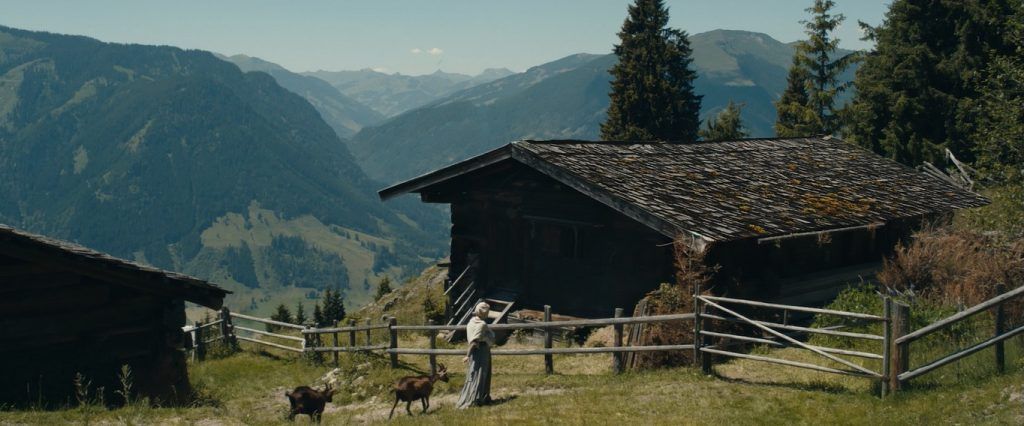
The film's visual language represents one of contemporary cinema's most stunning achievements in atmospheric horror. Cinematographer Mariel Baqueiro creates images that feel both achingly beautiful and deeply unsettling, transforming the Alpine landscape into something that seems to exist outside normal time and space. The forest becomes a character in its own right, ancient and watchful, while the mountain hut where Albrun lives feels like a place where the boundaries between civilization and wilderness have completely dissolved.
Feigelfeld's use of natural light creates a world that feels authentically medieval yet timelessly ominous. The long winter sequences, with their gray skies and skeletal trees, establish an atmosphere of perpetual twilight where anything might emerge from the shadows. When spring finally arrives, the renewed life of the forest feels less like rebirth and more like the awakening of something that has been waiting through the cold months.
The sound design deserves recognition as one of horror cinema's most effectively unsettling audio landscapes. MMMD's score combines traditional folk instruments with electronic manipulation to create soundscapes that feel both ancient and utterly modern. The music doesn't simply accompany the action—it becomes part of the film's fabric, suggesting the presence of forces that exist beyond human understanding. The natural sounds of the forest—wind through trees, animal calls, the creaking of wood—are amplified and distorted until they become instruments of psychological pressure.
The film's approach to witchcraft avoids both historical accuracy and modern genre conventions, instead creating something that feels like accessing collective unconscious fears about feminine power and social otherness. Albrun's transformation into a witch doesn't follow traditional narrative beats; instead, it unfolds organically from her psychological state and social circumstances. The supernatural elements feel less like fantasy and more like psychological reality made visible.
Hagazussa's treatment of motherhood and female isolation is particularly sophisticated, exploring how women who exist outside social norms become repositories for community fears and anxieties. Albrun's relationship with her infant daughter becomes increasingly disturbing as her grip on reality loosens, culminating in sequences that are genuinely difficult to watch but feel psychologically authentic rather than exploitative.
The film's exploration of religious themes demonstrates nuanced understanding of how Christianity's suppression of pagan traditions created psychological fault lines that could be exploited by trauma and isolation. The priest who visits Albrun represents not salvation but another form of oppression, his attempts to "help" her serving only to further her alienation from human community.
Feigelfeld's direction shows remarkable restraint and confidence, trusting audiences to engage with material that demands active participation rather than passive consumption. The film's pacing is deliberately challenging, with extended sequences of atmospheric buildup that some viewers will find tedious but others will recognize as essential to the film's hypnotic power. This is horror as meditation, requiring viewers to enter a different relationship with narrative time.
The production design creates a world that feels authentically historical yet removed from specific time periods. The costumes, props, and locations suggest medieval Europe without being bound by strict historical accuracy, creating a space where folk horror can operate according to its own internal logic rather than documentary realism.
The film's final act represents one of contemporary horror's most genuinely disturbing conclusions, a sequence that feels like witnessing something that should remain private and forbidden. The transformation of Albrun's grief and rage into something actively malevolent feels both shocking and inevitable, the logical conclusion of everything the film has been building toward.
Hagazussa's technical execution is flawless throughout, demonstrating that visionary horror can be achieved through careful attention to craft rather than expensive special effects. Every element—cinematography, sound design, production design, performance—serves the film's central vision of psychological breakdown as supernatural transformation.
The film's themes of social isolation, feminine otherness, and the thin boundaries between sanity and madness feel urgently contemporary despite the historical setting. Feigelfeld has created a work that uses folk horror traditions to explore psychological states that remain relevant to modern audiences, particularly women who have experienced social ostracism or psychological trauma.
Hagazussa operates in the tradition of films like The Witch and Midsommar, but it establishes its own distinct voice within the folk horror renaissance. Where other films might rely on period details or explicit supernatural manifestations, Feigelfeld creates horror through pure atmosphere and psychological authenticity.
The film demands to be experienced rather than simply watched, requiring viewers to surrender to its rhythms and internal logic. Those willing to engage with its challenging approach will find themselves rewarded with one of contemporary horror's most genuinely unsettling experiences, a work that lingers in the consciousness long after viewing.
Hagazussa stands as proof that horror cinema's artistic potential remains largely untapped, demonstrating what can be achieved when filmmakers trust audiences to engage with difficult, uncompromising material. It's a film that doesn't simply frighten—it alters perception, creating a viewing experience that feels genuinely transformative. In a genre often content with familiar formulas, Feigelfeld has created something genuinely unique and deeply disturbing, a work that honors folk horror's capacity to access our most primal fears while establishing new possibilities for what atmospheric horror can achieve.