Directed by David Lynch
10/10
3/10
8.5/10
10/10
10/10
10/10
The Nightmare at the Heart of Everything: Lynch's Industrial Fever Dream
David Lynch's Eraserhead doesn't simply invite you into horror—it pulls you through the looking glass into a world where the very fabric of reality operates according to nightmare logic, where every frame throbs with industrial dread and existential terror. This isn't horror in any traditional sense; it's something far more primal and disturbing, a sustained descent into a mental landscape where domesticity becomes body horror, parenthood becomes cosmic punishment, and ordinary existence reveals itself as an absurdist nightmare from which there is no awakening. Nearly five decades after its creation, Eraserhead remains Lynch at his most purely Lynchian, an immaculate transmission from the darkest corners of the unconscious that refuses to be categorized, explained, or forgotten.
To call Eraserhead a film about fear of fatherhood is both accurate and woefully insufficient. Lynch, working on his debut feature over five years of guerrilla production, created something that transcends simple interpretation—a work that operates on the level of pure dream imagery and primal anxiety. Henry Spencer's journey through an industrial wasteland of crying babies, radiator ladies, and horrific biological realities becomes a meditation on masculine anxiety, creative paralysis, and the terror of being trapped in an existence that offers no escape or meaning.
Jack Nance delivers one of cinema's most indelible performances as Henry Spencer, creating a character whose blank-faced passivity becomes increasingly horrifying as we realize it's his only defense against a reality too awful to fully process. Nance's Henry is a study in dissociation—watch how his eyes rarely seem to fully register what's happening around him, how his face maintains the same shell-shocked expression whether encountering casual conversation or cosmic horror. It's a performance that shouldn't work by conventional standards but becomes absolutely essential to the film's dream logic, suggesting a consciousness that has already partially evacuated its own body.
Lynch's visual language represents nothing less than a complete reimagining of what cinema can look like. Working with cinematographer Frederick Elmes and production designer Jack Fisk, Lynch creates a world rendered entirely in blacks, whites, and grays that feels both hyper-real and completely unmoored from recognizable reality. Every frame is meticulously composed yet feels organically nightmarish, as if we're witnessing not a constructed set but actual landscapes of the unconscious mind made visible.
The film's setting—an unnamed industrial city of belching smokestacks, empty streets, and decrepit apartments—becomes the physical manifestation of psychological decay. Lynch transforms urban industrial blight into something almost mythological, suggesting that this isn't simply a location but a state of being, a purgatory where souls go to confront their deepest fears about existence, biology, and the trap of flesh itself.
The sound design stands as one of cinema's most extraordinary achievements in auditory horror. Lynch and sound designer Alan Splet created an environment where industrial noise, organic sounds, and indeterminate drones merge into a constant low-frequency assault that induces actual physical anxiety in viewers. The soundscape doesn't simply accompany the visuals—it becomes the film's nervous system, a throbbing industrial heartbeat that suggests vast machinery grinding away just beyond our perception. This is sound as texture, as atmospheric pressure, as existential weight pressing down on everything.
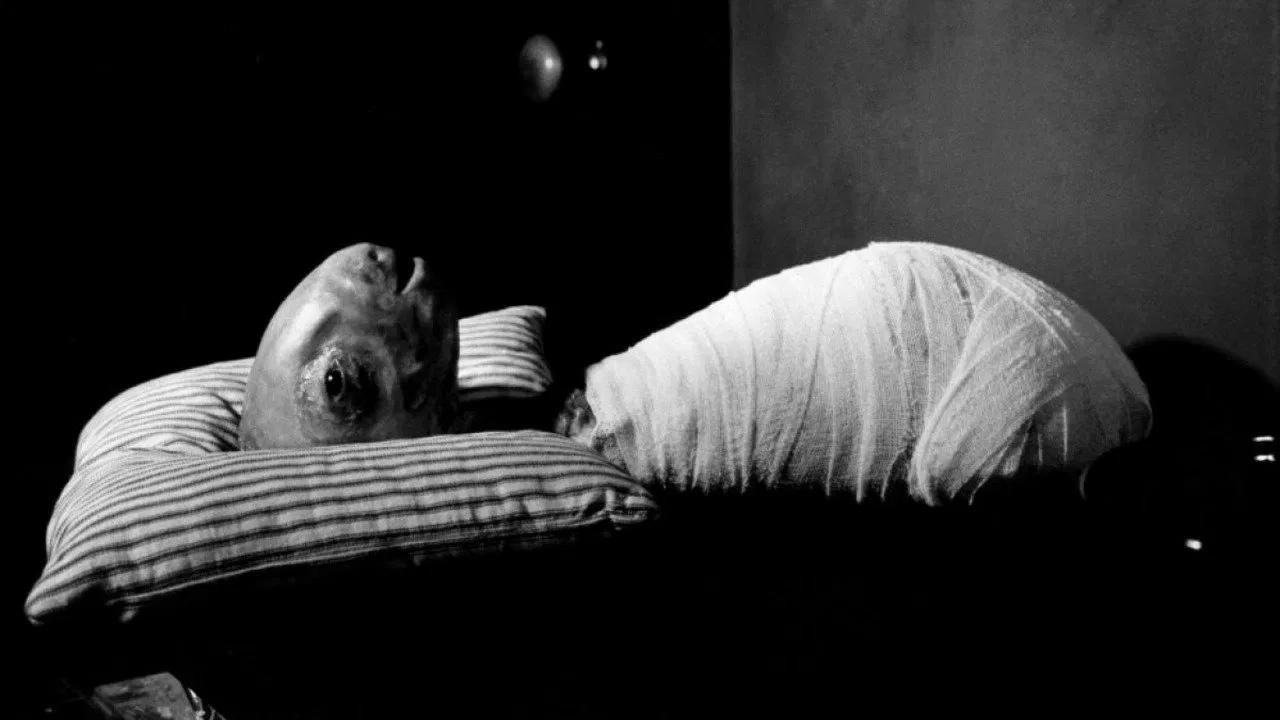
The film's most notorious element—the baby—represents body horror at its most psychologically devastating. The creature (whose creation method Lynch has famously never revealed) exists in that uncanny valley between recognizably human and utterly alien, between pitiable and repulsive. The baby's constant crying becomes not just sound but metaphysical assault, the audio embodiment of responsibility, biological destiny, and the horror of being needed by something you cannot understand or properly care for.
Lynch's direction shows absolute mastery of pace and rhythm, understanding that nightmare logic requires different temporality than conventional narrative. Scenes unfold with dream-like duration—sometimes too slow, sometimes too fast, never quite matching our expectations. This temporal manipulation creates profound disorientation, making us feel like we're experiencing events through the distorted perception of someone undergoing psychological breakdown.
The famous "Lady in the Radiator" sequences represent Lynch's ability to find strange beauty within nightmare. These musical interludes, featuring the disfigured Lady singing "In Heaven, Everything is Fine," provide the only moments of something approaching comfort in Henry's existence, yet they're so deeply weird that even this respite feels contaminated by the surrounding horror. The Lady becomes both angel and grotesque, salvation and delusion.
The film's exploration of sexuality and biological reality is particularly disturbing, presenting all bodily functions and intimacy as fundamentally horrific. The dinner scene, with its oozing miniature chickens and mounting sexual tension, becomes a masterclass in making the familiar absolutely alien. Lynch suggests that beneath social niceties and domestic normalcy lurks something wet, squirming, and incomprehensible—biology as cosmic joke.
Eraserhead's thematic density rewards endless interpretation while resisting definitive explanation. It functions simultaneously as meditation on creative anxiety (Lynch made it while struggling with his own fears about fatherhood and artistic voice), critique of industrial modernity, exploration of masculine inadequacy, and pure nightmare imagery that bypasses intellectual analysis entirely. The genius is that Lynch never privileges one reading over others, allowing the film to exist as genuine dream—meaningful without being reducible to simple metaphor.
The technical execution, achieved on an impossibly small budget through years of patient accumulation of footage, represents a triumph of vision over resources. Every limitation becomes an aesthetic choice—the black-and-white cinematography isn't nostalgic but otherworldly, the minimal sets feel deliberately claustrophobic, the limited cast suggests a world where other people barely register as real.
The film's influence on subsequent horror and experimental cinema cannot be overstated. Eraserhead essentially created the template for what we now call "art horror," proving that genre cinema could achieve avant-garde artistic ambitions without abandoning its fundamental commitment to generating dread and unease. Everything from The Fly to Antichrist to Possessor owes a debt to Lynch's demonstration that body horror and existential terror could be vehicles for serious artistic expression.
The famous ending, with its vision of Henry's head literally transformed into eraser material, provides one of cinema's most enigmatic and disturbing conclusions. Whether interpreted as death, transcendence, or final dissociation, the sequence feels both shocking and inevitable—the logical endpoint of a journey into complete psychological fragmentation.
What makes Eraserhead endure as one of horror's supreme achievements is its absolute refusal to provide comfort, explanation, or escape. This is a film that understands horror not as discrete moments of fear but as a sustained state of existential dread, an atmosphere so thick with anxiety that simply existing within it becomes almost unbearable. Lynch created a world that feels genuinely haunted—not by ghosts or monsters but by the horror of consciousness itself, of being trapped in biology and circumstance with no way out except through.
Eraserhead represents Lynch at his most uncompromising and visionary, before commercial pressures or audience expectations could dilute his singular vision. It's a film that doesn't care if you understand it or even like it; it simply is, radiating nightmare logic and industrial dread with the confidence of pure artistic vision. In a genre often content with providing thrills and then releasing audiences back into normalcy, Lynch created something that fundamentally alters perception, that makes the ordinary world seem slightly wrong forever after.
This is horror that doesn't announce itself with fanfare but seeps into consciousness like industrial pollutant, contaminating everything it touches. It's a masterpiece that proves horror's highest achievement isn't simply to scare but to fundamentally change how we experience reality itself—to show us that the nightmare isn't something we wake up from, but something we've been living in all along