
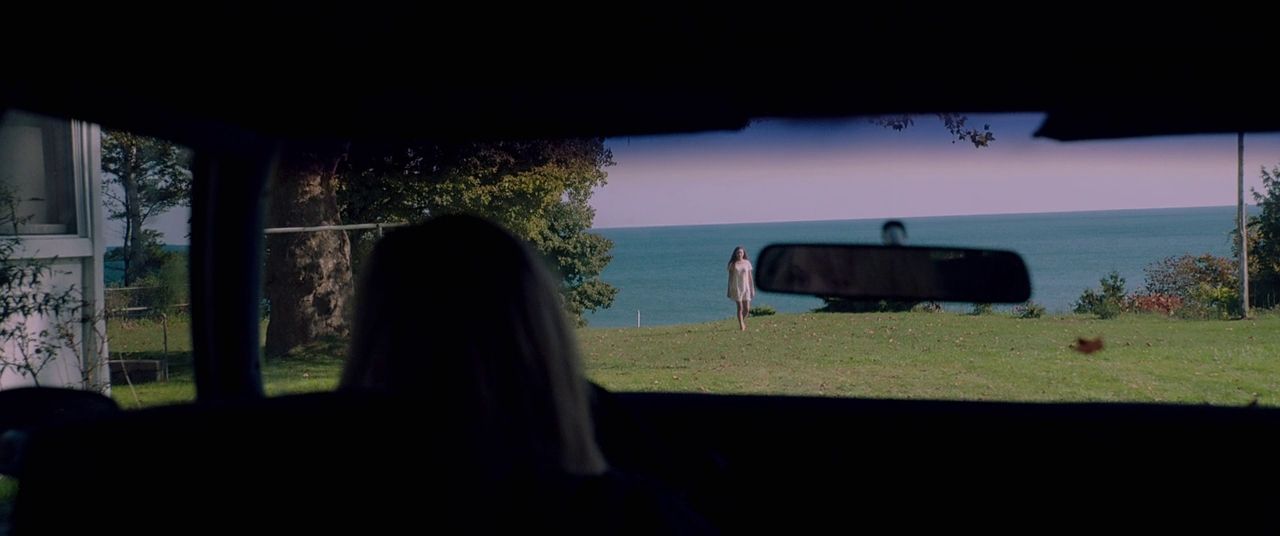
Directed by David Robert Mitchell
10/10
5/10
4/10
10/10
10/10
10/10
The Perfect Horror Machine: Death as Inevitable Stalker
David Robert Mitchell's It Follows doesn't simply represent one of the finest horror films of the modern era—it stands as perhaps the most perfectly constructed piece of genre filmmaking ever created, a work so precisely calibrated and thematically rich that it transcends its supernatural premise to become something approaching pure cinematic poetry. This is horror at its most elemental and sophisticated, a film that uses the simplest possible concept—something is following you, and it will never stop—to create an experience that feels both timelessly primal and urgently contemporary.
The film's genius lies in its recognition that the most effective horror comes from anxieties that already exist within us, fears that the supernatural elements merely make literal and visible. The entity that stalks Jay and her friends operates as a perfect metaphor for any number of inescapable realities—death, sexual trauma, the loss of innocence, the weight of adult responsibility—while remaining genuinely terrifying as a supernatural threat in its own right.
Maika Monroe delivers a performance of remarkable subtlety and authenticity as Jay, creating a character who feels like an actual teenager rather than a horror movie protagonist. Monroe navigates Jay's journey from carefree adolescent to marked woman with such naturalistic grace that we never question the reality of her experience, even as that experience becomes increasingly surreal. Her portrayal captures something essential about the transition from childhood to adulthood—the sudden awareness that certain choices have permanent consequences, that some doors, once opened, can never be closed.
The supporting cast creates a vivid portrait of suburban adolescence that feels both specific to its Detroit setting and universally recognizable. Keir Gilchrist as Paul, Lili Sepe as Kelly, Daniel Zovatto as Greg, and Olivia Luccardi as Yara form a friend group that feels genuinely lived-in, their relationships carrying the weight of shared history and authentic affection. These performances are crucial to the film's success because they make us care about these characters as people rather than simply horror movie victims.
Mitchell's visual language represents one of contemporary cinema's most sophisticated achievements in atmospheric horror. Working with cinematographer Mike Gioulakis, he creates a world that feels both recognizably suburban and subtly dreamlike, where every wide shot becomes a source of potential menace. The film's use of 360-degree pans creates a sense of constant surveillance, while the frequent wide shots force audiences to scan the frame for threats, making us active participants in the characters' paranoia.
The film's approach to its supernatural antagonist demonstrates masterful understanding of how less can be more in horror. The entity never runs, never hurries, never deviates from its methodical pursuit—qualities that make it far more terrifying than any slavering monster could be. Its various forms, from anonymous strangers to deceased loved ones, suggest something that understands human psychology well enough to weaponize our deepest emotional vulnerabilities.
Rich Vreeland's synthesizer score deserves recognition as one of horror cinema's greatest musical achievements, a work that functions both as perfect accompaniment to the visual action and as a standalone piece of electronic art. The music doesn't simply create atmosphere—it becomes part of the film's DNA, its pulsing rhythms and ethereal melodies creating an audio landscape that feels both nostalgic and futuristic. The score's ability to make simple synthesizer tones feel genuinely threatening represents a masterclass in how music can transform visual information.
The film's production design creates a world that exists outside specific time periods, combining elements from different decades to create a space where the story can operate according to its own internal logic. The mix of 1970s cars, 1980s electronics, and contemporary elements creates a timeless quality that prevents the film from feeling dated while suggesting that the themes it explores are permanent features of human experience.
It Follows' treatment of sexuality is particularly sophisticated, avoiding both puritanical moralizing and exploitative titillation. The film understands that sex is both a source of connection and potential danger, that intimacy inevitably involves risk and vulnerability. The entity's transmission through sexual contact doesn't function as punishment for sexual activity but as recognition that all meaningful human connections carry potential consequences.
The film's exploration of suburban malaise captures something essential about contemporary American adolescence—the sense of being trapped in spaces that feel both protective and limiting, the awareness that the adult world offers fewer certainties than childhood mythology suggested. The Detroit setting, with its abandoned buildings and economic decay, provides the perfect backdrop for a story about young people confronting the possibility that their futures may be more precarious than they imagined.
Mitchell's direction maintains perfect control throughout, never allowing the film to tip into either camp or pretension despite its high-concept premise. He treats every moment with complete seriousness while maintaining the naturalistic tone that makes the supernatural elements feel believable. The film's pacing builds tension through accumulation rather than escalation, creating a sense of mounting dread that never lets up.
The film's famous pool sequence represents one of contemporary horror's most perfectly orchestrated set pieces, a scene that demonstrates how careful planning and execution can create genuine suspense without relying on cheap thrills. The sequence works because it emerges naturally from the characters' logical attempts to solve their problem, while the entity's response feels both surprising and inevitable.
It Follows' ending, which leaves the threat unresolved while suggesting the possibility of hope, demonstrates sophisticated understanding of how horror conclusions should function. The film doesn't provide easy answers or false comfort, instead suggesting that the characters have found a way to live with uncertainty and danger—perhaps the most adult response possible to the human condition.
The film's themes of mortality, sexual awakening, and the loss of innocence feel both timeless and specifically relevant to contemporary anxieties about STDs, sexual assault, and the general precariousness of modern existence. Mitchell has created a work that functions as both supernatural thriller and serious meditation on what it means to grow up in a world where safety is always temporary and death is always approaching.
The technical execution is flawless throughout, with every element—cinematography, sound design, editing, production design—serving the film's central vision. The result is a work that feels completely unified, where every choice seems inevitable and necessary rather than arbitrary or calculated.
It Follows represents the absolute pinnacle of what horror cinema can achieve when vision, craft, and thematic sophistication align perfectly. It's a film that doesn't simply frighten—it fundamentally alters how we think about fear, mortality, and the price of human connection. In an era when horror often settles for easy scares or obvious social commentary, Mitchell has created something genuinely transcendent, a work that honors both the genre's capacity for visceral impact and its potential for serious artistic expression.
This is horror as perfect machine, every component calibrated to produce maximum emotional and psychological effect while serving deeper themes about the human condition. It Follows stands as proof that contemporary horror can achieve genuine artistic greatness while never forgetting its primary obligation to absolutely terrify.