Directed by Masaki Kobayashi
9/10
3/10
6/10
9/10
10/10
10/10
Ghost Stories as Living Paintings: Horror Elevated to Pure Art
Masaki Kobayashi's Kwaidan doesn't simply tell ghost stories, he transforms them into something approaching religious experience, a three-hour journey through four tales of the supernatural that achieves a level of aesthetic perfection rarely seen in any cinema, let alone horror. This is filmmaking as high art, each frame composed with painterly precision, every sound designed with musical sophistication, the entire endeavor representing horror cinema's capacity for transcendent beauty. Adapted from Lafcadio Hearn's collections of Japanese folklore, Kwaidan stands as proof that genre cinema can achieve the highest levels of artistic expression while maintaining its fundamental commitment to generating genuine uncanny dread.
The anthology structure presents four distinct tales—"The Black Hair," "The Woman of the Snow," "Hoichi the Earless," and "In a Cup of Tea"—each exploring different aspects of Japanese supernatural tradition while maintaining thematic coherence around betrayal, consequence, and the persistence of the past. Kobayashi's genius lies in treating each story with absolute seriousness and aesthetic commitment, never allowing the episodic structure to diminish the impact of individual tales.
"The Black Hair" opens the film with devastating emotional weight, following a samurai who abandons his devoted wife for social advancement only to discover, years later, that some betrayals create consequences that transcend death itself. The story works as both ghost tale and meditation on guilt, the supernatural manifestations emerging organically from psychological truth. The final revelation—the wife's preserved corpse and the horror of the protagonist's realization—represents body horror achieved through implication and atmospheric dread rather than explicit imagery.
"The Woman of the Snow" tells of a woodcutter who encounters a deadly snow spirit and years later discovers she's been living among humans as his wife. This tale showcases Kobayashi's ability to find beauty within terror, the snow woman simultaneously enchanting and lethal. The story explores themes of secrets within intimacy, the danger of revealed truth, and the tragic impossibility of certain relationships. The winter landscapes become characters themselves, vast white expanses suggesting both purity and death.
"Hoichi the Earless," the film's longest and most elaborate segment, follows a blind monk whose musical genius attracts the attention of samurai ghosts seeking remembrance of their ancient battle. This tale represents the film's most overtly spectacular sequence, featuring an extended recreation of the Battle of Dan-no-ura rendered in Kobayashi's theatrical, stylized aesthetic. The story explores art's relationship with death and memory, suggesting that creative expression can become a bridge between worlds that perhaps should remain separate.
"In a Cup of Tea" presents an incomplete tale about a samurai who repeatedly encounters a mysterious man's reflection in his tea, only to be visited by the man's retainers seeking their lost master. The deliberately unfinished nature of this final story—ending with a narrator explaining that the manuscript breaks off—creates a meta-textual dimension that honors the oral tradition of ghost storytelling while suggesting that some hauntings continue beyond narrative closure.
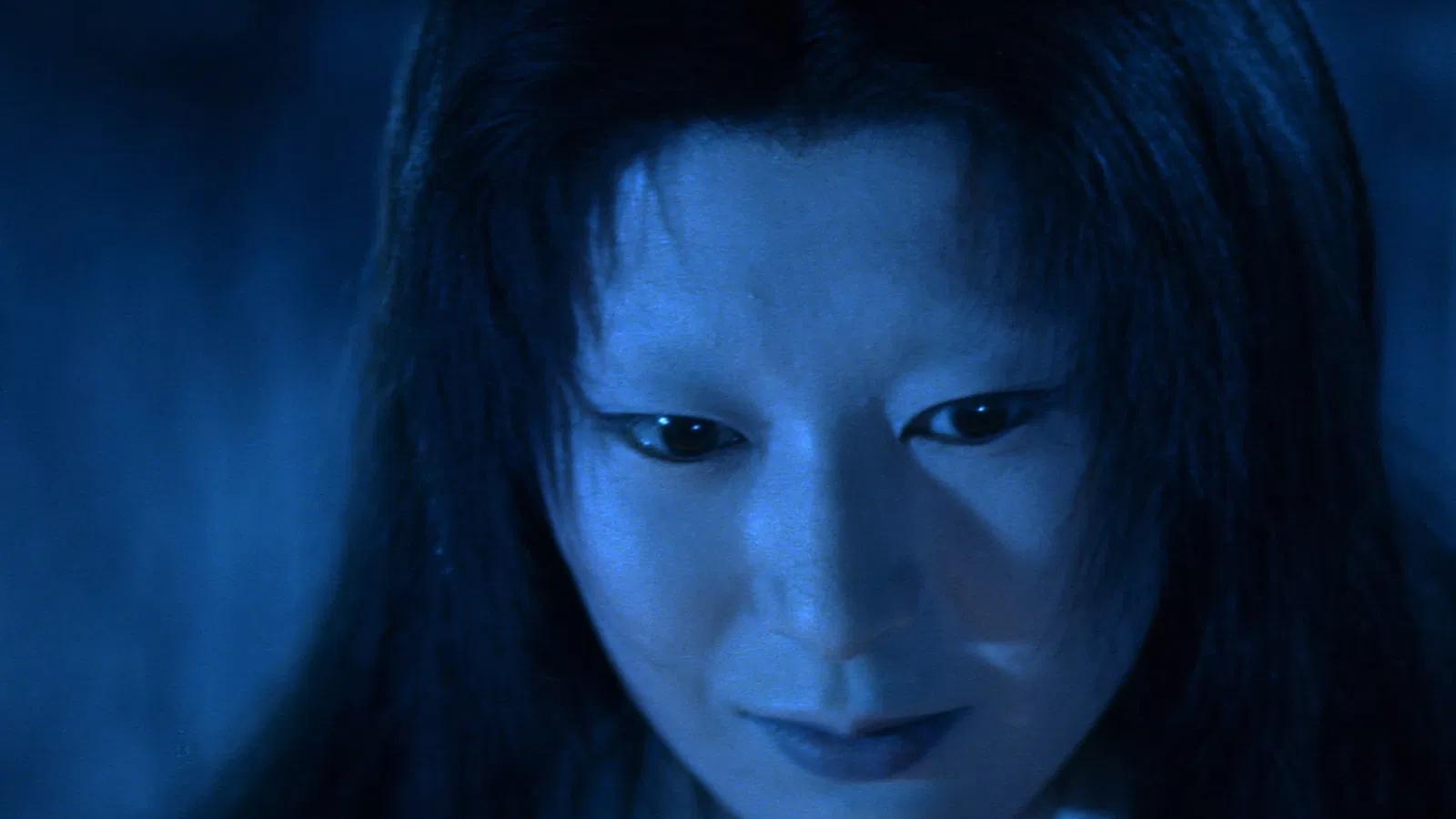
The film's visual language represents one of cinema's supreme aesthetic achievements. Kobayashi and cinematographer Yoshio Miyajima create images of such breathtaking beauty that individual frames could hang in museums. The decision to shoot entirely on massive studio sets rather than natural locations allows complete control over every visual element, resulting in a world that feels simultaneously hyperreal and completely artificial—like witnessing stories unfold within living woodblock prints.
The color palette deserves particular recognition for its bold, expressionistic choices. Rather than naturalistic color, Kobayashi employs vivid reds, deep blues, stark whites that feel almost aggressive in their intensity. The famous eye-in-the-sky shot from "Hoichi" presents a painted backdrop so stylized it becomes almost abstract, suggesting cosmic forces observing human folly. This approach transforms realism into something more truthful—the emotional and spiritual reality of ghost stories rather than their literal appearance.
The production design creates environments that exist somewhere between historical accuracy and theatrical abstraction. The sets feel both meticulously detailed and deliberately artificial, acknowledging their constructed nature while using that artificiality to create aesthetic impact impossible in natural locations. This approach honors Japanese theatrical traditions—Noh drama, Kabuki theater—where stylization serves emotional truth.
Tōru Takemitsu's score represents one of horror cinema's most sophisticated musical achievements. Rather than traditional orchestral horror scoring, Takemitsu creates soundscapes that blend traditional Japanese instruments with avant-garde composition techniques, electronic manipulation, and extended passages of ambient sound. The result feels simultaneously ancient and modern, creating audio textures that enhance the supernatural atmosphere while maintaining their own artistic integrity. The music doesn't simply accompany the action—it becomes part of the film's fabric, suggesting the presence of forces beyond human comprehension.
The sound design extends this approach, using carefully crafted audio environments to create unease through suggestion rather than obvious manipulation. The wind through trees, distant voices, the particular quality of silence in abandoned spaces—all these elements receive the same meticulous attention as the visual components, creating total sensory immersion in each tale's world.
The performances throughout maintain perfect pitch between naturalism and theatrical stylization. The actors understand they're operating within a heightened aesthetic reality while grounding their characters in recognizable human emotion. Rentarō Mikuni, Michiyo Aratama, Katsuo Nakamura, and the ensemble cast navigate between emotional authenticity and formal precision, honoring both the human stories and their supernatural contexts.
Kobayashi's direction shows absolute mastery of pacing and rhythm, understanding that effective ghost stories require patience and accumulation rather than constant stimulation. He allows scenes to unfold at their own pace, trusting audiences to engage with material that demands active attention. The film's three-hour runtime feels necessary rather than indulgent, each story receiving the time required to establish its world, develop its characters, and deliver its supernatural revelations.
The film's approach to horror avoids cheap scares or graphic violence, instead creating dread through atmosphere, implication, and the gradual revelation of supernatural presence. The horror in Kwaidan emerges from the collision between human desire and supernatural consequence, from the realization that certain actions create ripples that extend beyond death and time.
Kwaidan's themes explore fundamental aspects of Japanese culture and philosophy—the weight of duty and honor, the persistence of the past, the relationship between the living and the dead, the consequences of betrayal. Yet these themes feel universal rather than exclusively cultural, speaking to fundamental human experiences of guilt, loss, and the haunting power of memory.
The technical execution represents a triumph of craft and vision. Every element—cinematography, production design, costume design, makeup, sound, music—exists at the highest possible level of achievement. The film demonstrates what can be accomplished when artistic vision receives adequate resources and time, when commercial considerations don't compromise aesthetic integrity.
The film's influence on subsequent horror cinema, particularly Asian ghost stories, cannot be overstated. The slow-burn approach, emphasis on atmosphere over explicit scares, integration of cultural folklore with serious artistic ambition—all these elements established templates that filmmakers continue to draw upon. Films from Onibaba to Ringu to contemporary J-horror owe a debt to Kwaidan's demonstration that ghost stories could be vehicles for high art.
What makes Kwaidan endure as a masterpiece is its absolute commitment to treating ghost stories with the seriousness and aesthetic attention usually reserved for prestige drama. Kobayashi never condescends to his material or treats supernatural elements as inherently less worthy of artistic effort. Instead, he elevates folklore to the level of myth, creating a work that honors both entertainment and art.
The film stands as proof that horror cinema's potential for beauty remains largely unexplored by Western filmmakers. While American horror often emphasizes shock and visceral impact, Kwaidan demonstrates that terror can be achieved through aesthetic perfection, that beauty and horror need not be opposites but can enhance and amplify each other.
Kwaidan represents horror cinema at its most ambitious and achieved, a film that proves genre work can reach the highest levels of artistic expression while maintaining its fundamental purpose of creating uncanny dread. It's a masterpiece that doesn't simply frighten—it transforms perception, demonstrating that ghost stories can be simultaneously terrifying and transcendently beautiful. In a genre too often dismissed as lowbrow entertainment, Kobayashi created something that demands to be recognized as genuine art, a work that honors horror's capacity for aesthetic excellence while never forgetting the dark power of well-told tales of the supernatural. This is cinema as séance, as ritual, as bridge between worlds—a masterpiece on every conceivable level.