
10/10
7.5/10
8.5/10
10/10
10/10
10/10
The Perfection That Destroys: Ballet as Descent into Beautiful Madness
Darren Aronofsky's Black Swan doesn't simply explore psychological breakdown—it traps you inside one, creating a claustrophobic nightmare of perfectionism and self-destruction that screeches and claws at your consciousness for its entire runtime. This is horror as haute couture, a film that transforms the pursuit of artistic perfection into a sustained assault on sanity that feels both exquisitely beautiful and absolutely relentless. Aronofsky has created a masterpiece of psychological terror that proves horror's capacity to explore the darkest corners of artistic obsession while delivering visceral, body-horror shocks that leave you gasping.
The film follows Nina Sayers, a technically perfect but emotionally repressed ballet dancer who lands the dual role of White Swan/Black Swan in a new production of Swan Lake. What begins as a portrait of artistic ambition quickly spirals into full-blown psychological horror as Nina's quest for perfection dissolves the boundaries between reality and hallucination, self and other, control and complete surrender to darkness.
Natalie Portman delivers what may be the greatest performance in horror cinema history as Nina, a tour de force of physical and psychological commitment that makes her Oscar win feel almost insufficient recognition. Portman doesn't simply portray psychological breakdown—she embodies it so completely that watching her becomes almost unbearable. Notice how she physically transforms throughout the film: the perfect posture gradually contorting, the controlled movements giving way to spasms and twitches, the pristine ballerina body revealing wounds both real and imagined. This is acting as total immersion, Portman allowing herself to be completely consumed by a character whose identity is literally disintegrating.
The supporting performances create a perfect ecosystem of pressure and manipulation. Mila Kunis as Lily provides the shadow self that Nina both desires and fears to become—sensual, spontaneous, dangerous. Vincent Cassel as Thomas Leroy embodies predatory artistic authority, his director simultaneously nurturing Nina's talent and exploiting her vulnerability. Barbara Hershey as Erica creates one of cinema's most suffocating mother figures, her love indistinguishable from control, her concern inseparable from sabotage.
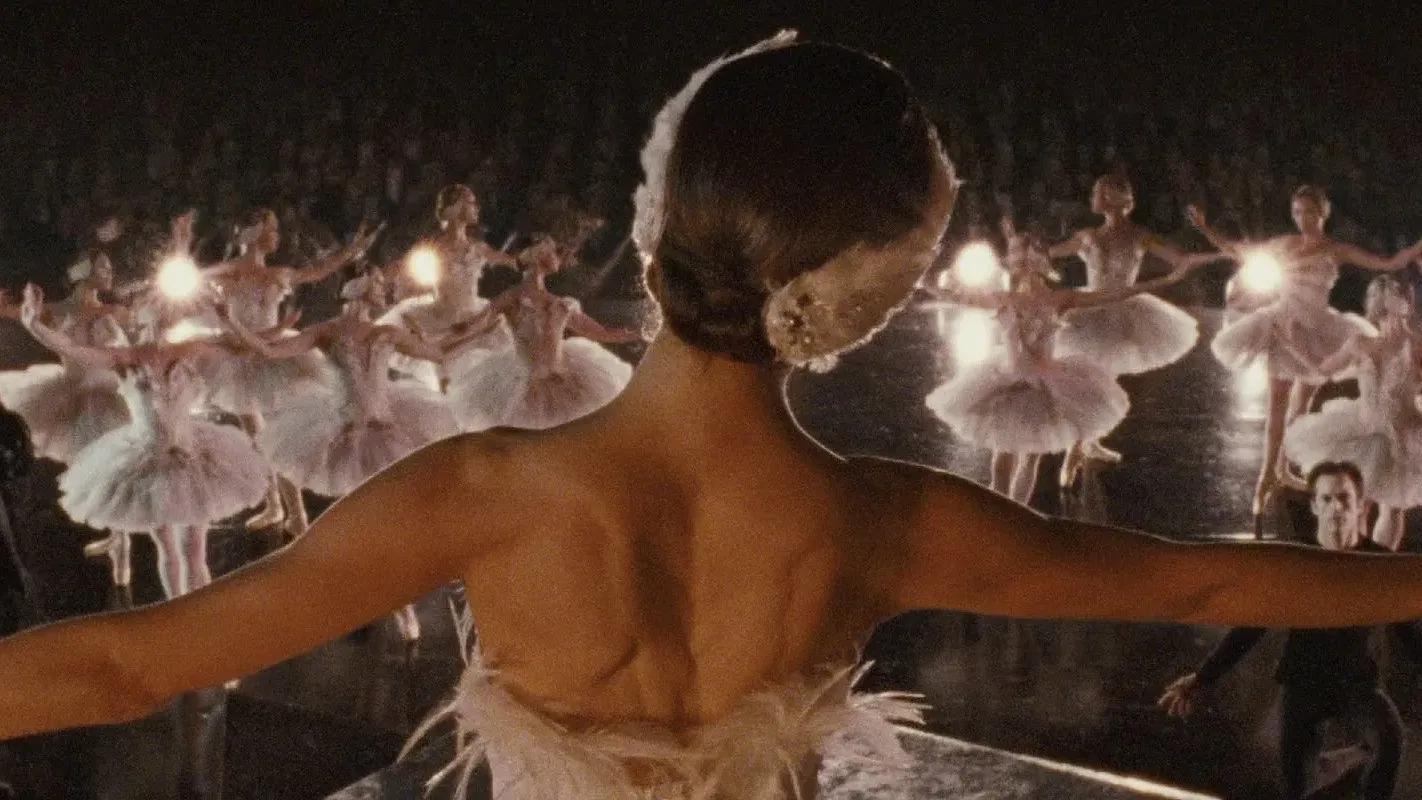
Aronofsky's visual language is nothing short of masterful, creating a world that feels simultaneously hyper-real and dreamlike. Working with cinematographer Matthew Libatique, he employs handheld camerawork that follows Nina with stalker-like intimacy, the camera often positioned directly behind her shoulder as if we're her shadow or conscience. This creates profound claustrophobia—we're trapped in Nina's perspective, unable to distinguish between objective reality and her fragmenting perception.
The film's use of mirrors deserves particular recognition as one of cinema's most effective deployments of reflective surfaces. Mirrors multiply throughout Nina's world, creating infinite regression of selves until the concept of a "real" Nina becomes meaningless. Aronofsky uses reflections to suggest doubling, splitting, the presence of something other lurking just beneath the surface. The famous mirror scenes—Nina's reflection moving independently, transforming into something darker—represent horror imagery that works because it literalizes genuine psychological experience.
The sound design creates an atmosphere of constant, escalating tension that feels almost like physical assault. The screeching strings, distorted Tchaikovsky, ambient noise of the theater, Nina's labored breathing—all combine into an auditory landscape that never allows release or relief. Clint Mansell's score takes the familiar Swan Lake music and transforms it into something increasingly distorted and nightmarish, the beautiful classical compositions gradually consumed by electronic manipulation and dissonance.
The film's approach to body horror is particularly sophisticated, using Nina's physical transformation as both metaphor and literal terror. The peeling skin, the growing feathers, the webbed feet—these manifestations blur the line between psychological hallucination and actual metamorphosis. Aronofsky treats the body as battleground where Nina's internal war plays out in flesh and blood, making abstract psychological concepts viscerally, grotesquely physical.
Black Swan's exploration of female sexuality and repression is complex and often disturbing. Nina's journey toward embodying the Black Swan requires embracing sexuality and darkness that her upbringing has systematically denied. The film's sexual content—the club scene, the hallucinated encounter with Lily, Nina's masturbation—isn't gratuitous but essential to understanding her psychological prison. Aronofsky shows how sexual repression and artistic obsession intertwine, how the body denied becomes the body that rebels in increasingly disturbing ways.
The film's treatment of perfectionism and artistic obsession feels urgently contemporary, speaking to a culture increasingly defined by impossible standards and self-surveillance. Nina represents the logical endpoint of perfectionist thinking—the belief that if she can just control everything, execute flawlessly, eliminate every flaw, she'll achieve transcendence. Instead, this pursuit of perfection leads only to fragmentation and self-destruction.
Aronofsky's direction maintains relentless intensity throughout, never allowing audiences to catch their breath or regain stable footing. The pacing feels like a panic attack made cinematic—moments of seeming calm that only increase tension, sudden eruptions of horror, an overall sense of reality becoming increasingly unstable. This is filmmaking as sustained anxiety, every frame vibrating with barely contained madness.
The production design creates a world of whites, blacks, and pinks that gradually becomes contaminated by darkness. Nina's bedroom, with its pink walls and stuffed animals, represents arrested development and infantilization. The theater becomes a labyrinth of mirrors and shadows where reality and performance blur completely. The contrast between the sterile perfection of Nina's world and the wet, organic horror of her transformation creates visual tension that never resolves.
The film's use of the Swan Lake narrative as structural framework demonstrates sophisticated understanding of how myth and story can provide skeleton for psychological exploration. Nina's journey parallels the ballet's narrative—the pure swan corrupted, destroyed by the very transformation she seeks. Aronofsky makes this parallel explicit without being heavy-handed, allowing the ballet's themes to illuminate Nina's experience while maintaining the film's psychological realism.
The famous transformation sequence during the final performance represents one of cinema's most perfect fusions of horror and beauty. As Nina finally achieves the Black Swan's abandon and sensuality, Aronofsky gives us glimpses of actual transformation—feathers, wings, inhuman eyes—that may or may not be hallucination. The ambiguity is essential; by this point, the distinction between real and imagined has become meaningless.
The film's technical execution is flawless throughout, with editing by Andrew Weisblum creating rhythm that matches Nina's deteriorating mental state—tight, controlled cuts gradually giving way to more fragmented, disorienting sequences. The practical and digital effects blend seamlessly, making it impossible to distinguish where Nina's body ends and the special effects begin.
Black Swan's ending provides one of horror's most ambiguous yet emotionally devastating conclusions. Nina's final "I was perfect" represents both triumph and tragedy—she's achieved the artistic transcendence she sought but at the cost of everything, possibly including her life. Whether she literally dies or this represents complete ego death remains beautifully unclear, the ambiguity honoring the film's commitment to subjective reality.
The film's themes of artistic obsession, mother-daughter dysfunction, sexual repression, and the violence of perfectionism feel more relevant than ever in our achievement-obsessed culture. Aronofsky created a work that functions as both psychological horror masterpiece and searing critique of systems that demand perfection at any cost.
What makes Black Swan transcendent is how completely it commits to Nina's subjective experience while maintaining aesthetic control that never becomes indulgent. This is horror as total immersion, a film that doesn't simply show madness but makes you feel it viscerally, creating an experience that's simultaneously beautiful and absolutely harrowing.
The film's influence on subsequent psychological horror has been profound, establishing that art-house aesthetics and genre horror could merge completely, that psychological breakdown could be portrayed with unflinching intensity while maintaining mainstream accessibility. Everything from mother! to Pearl owes a debt to Black Swan's demonstration that horror could be both critically acclaimed and genuinely disturbing.
Black Swan stands as one of the 21st century's supreme horror achievements, a film that screeches and claws its way into your psyche and refuses to leave. It's a masterpiece that proves horror's capacity for artistic excellence while never forgetting its obligation to generate genuine terror and unease. Aronofsky created something that doesn't simply scare—it fundamentally alters how we understand the relationship between perfection and destruction, art and madness, the self we present and the darkness lurking beneath. In a genre too often content with surface-level thrills, Black Swan dives into the abyss and emerges with something beautiful, terrible, and absolutely unforgettable.