Directed by Charles Laughton
10/10
4/10
5/10
10/10
10/10
10/10
When Evil Came to the River: Cinema's Most Beautiful Nightmare
Charles Laughton's The Night of the Hunter stands as cinema's supreme achievement in visual poetry and sustained dread, a film so breathtakingly beautiful and profoundly terrifying that it exists in a category entirely its own. This is not simply one of horror's greatest films—it is one of the greatest films ever made in any genre, a work that synthesizes German Expressionism, silent film aesthetics, Southern Gothic literature, and fairy tale archetypes into something that has never been equaled or duplicated. That Laughton only directed this single film before returning permanently to acting remains one of cinema's great tragedies, yet this lone masterpiece proves sufficient to establish him as one of the medium's most visionary artists.
The film follows two children fleeing from Reverend Harry Powell, a self-proclaimed preacher and serial killer with "LOVE" and "HATE" tattooed on his knuckles, who marries and murders their mother to discover where their father hid stolen money. What could have been a simple thriller becomes something far more profound—a mythic journey through American darkness that operates simultaneously as nightmare, fairy tale, and searing indictment of false piety and masculine violence.
Robert Mitchum delivers the greatest villain performance in cinema history as Reverend Powell, creating a character who remains absolutely terrifying nearly seven decades later. Mitchum's Powell is sexual threat and religious authority merged into single predatory force, his charisma inseparable from his menace. Watch how he uses his voice—that sing-song cadence that makes biblical verse sound like lullaby and threat simultaneously, the way "Chil-dren!" becomes one of cinema's most chilling calls. Mitchum understood that the most effective monsters are those who can convince you they're saviors, making Powell's performance as much about seduction as terror.
The famous "love versus hate" sermon, with Mitchum's hands wrestling with each other as he preaches about the eternal struggle between good and evil, represents acting as pure physical poetry. The performance works because Mitchum never winks at the camera or signals Powell's evil—he plays the character's conviction absolutely straight, making him feel like genuine religious zealot whose faith happens to justify murder.
Lillian Gish as Rachel Cooper provides the film's moral center, delivering a performance of such quiet strength and grace that she becomes something approaching a guardian angel made flesh. Gish, one of silent cinema's greatest actresses, brings that entire tradition with her, her presence connecting the film to cinema's earliest days while establishing her as the children's protector against Powell's darkness. The confrontation between Gish and Mitchum—good and evil made literal—becomes one of cinema's most perfect symbolic battles.
The child performances from Billy Chapin and Sally Jane Bruce are remarkably naturalistic, grounding the film's mythic qualities in recognizable childhood fear and resilience. John's protective love for Pearl and gradual trauma feel authentically rendered, while Pearl's clutching of her doll (which contains the hidden money) becomes heartbreaking symbol of childhood innocence weaponized by adult corruption.
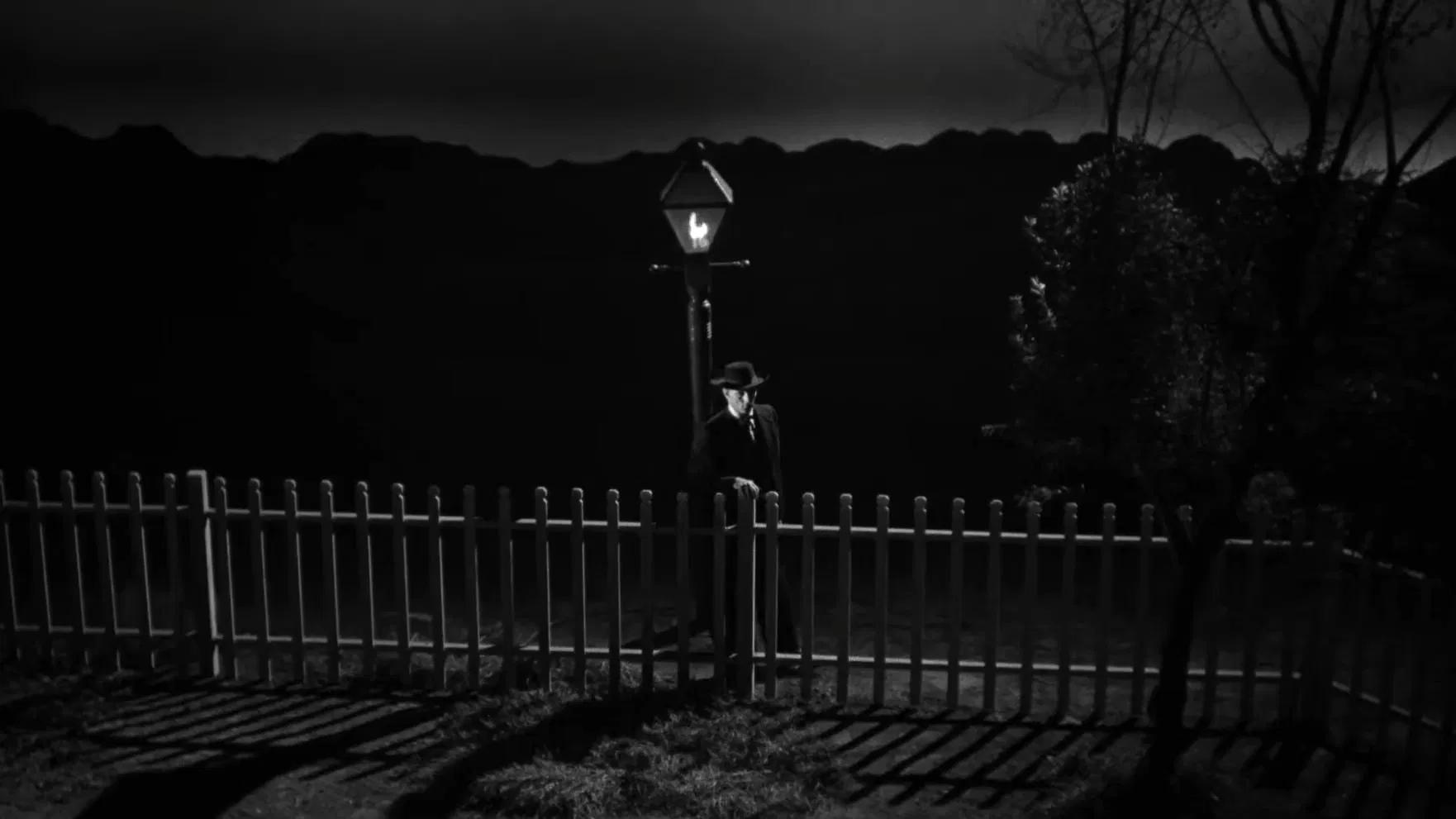
Laughton's visual language represents nothing less than a revolution in cinematic aesthetics. Working with cinematographer Stanley Cortez, he creates images that feel simultaneously realistic and completely stylized, existing in that impossible space between documentary naturalism and expressionist abstraction. The film's visual approach draws explicitly from D.W. Griffith's silents (particularly appropriate given Gish's presence), German Expressionism's stark contrasts and angular compositions, and American primitive painting's folk art simplicity.
The river journey sequence stands as one of cinema's most visually perfect sustained passages. As the children float downstream escaping Powell, Laughton creates images of surreal beauty—the boat drifting past animals on the shore, all rendered in obvious studio artificiality that somehow enhances rather than diminishes the emotional impact. The animals—rabbits, frogs, sheep—watch the children pass like witnesses to innocence in flight, their presence suggesting fairy tale logic where nature itself provides sanctuary.
The use of light and shadow throughout achieves perfection that has rarely been matched. Laughton and Cortez employ high-contrast black-and-white photography that makes every frame feel like a woodcut or shadow play. The famous shot of Powell's silhouette on the horizon, backlit and impossibly tall, becomes archetypal image of predatory threat. The wedding night sequence, with Willa's body underwater in the car, her hair flowing like river grass, represents beauty and horror merged so completely they become indistinguishable.
The film's approach to the Depression-era Ohio River Valley setting creates a world that feels both historically specific and timelessly mythic. The small-town poverty, the widow's desperation, the community's simultaneous religious devotion and moral bankruptcy—all these elements ground the story in recognizable American reality while the visual stylization lifts it into realm of universal nightmare.
Walter Schumann's score deserves recognition as one of cinema's most effective musical achievements. Rather than traditional orchestral horror, the music incorporates hymns, folk songs, and lullabies—particularly "Leaning on the Everlasting Arms," which Powell sings constantly, transforming religious comfort into sinister threat through pure context. The way familiar hymns become contaminated by association with evil represents sophisticated understanding of how music can be weaponized.
The sound design uses silence as effectively as any noise, creating moments where the absence of sound becomes almost unbearable. Powell's pursuit of the children through the cellar, his voice calling out in that sing-song tone, represents audio horror achieved through vocal performance rather than obvious musical manipulation.
Laughton's direction shows absolute mastery of pace and tone, navigating between realistic drama, fairy tale fantasy, and pure nightmare without ever losing control. The film shifts registers constantly—comic moments with Icey Spoon's gossip, terrifying sequences of Powell's pursuit, transcendent beauty in the river journey—yet maintains perfect tonal coherence. This is directing as orchestration, every element precisely calibrated to serve the whole.
The production design creates environments that feel both real and theatrical. The Harper house, with its cellar and creaking stairs, becomes gothic haunted house in Depression-era costume. Rachel's river shack transforms into fortress of feminine strength and sanctuary. Even the small-town streets feel like theatrical sets where American gothic drama plays out in shadow and light.
The Night of the Hunter's thematic complexity rewards endless analysis. The film operates as critique of toxic masculinity, false religiosity, economic desperation, and childhood trauma while never becoming didactic or losing its primary power as thriller. The contrast between Powell's perverted Christianity and Rachel's authentic faith suggests that true religion manifests in protection and love rather than violence and control.
The film's exploration of childhood perspective—the way children perceive adult evil, their strategies for survival, the trauma of witnessing violence—feels remarkably sophisticated for 1955. Laughton never patronizes his child characters or suggests they're simply innocent victims; instead, he shows their resilience and resourcefulness while acknowledging the permanent damage inflicted by adult cruelty.
The famous courtroom climax, where John finally breaks down and Pearl can only repeat "I won't tell," represents emotional devastation achieved through accumulated trauma rather than single shocking moment. The children's inability to articulate what they've experienced speaks to how profoundly evil can damage young psyches.
The film's ending, with Rachel's voiceover about children's endurance and resilience, provides closure without suggesting complete healing. The children have survived, found safety, but the film acknowledges they've been fundamentally changed by their experience. This honesty about trauma's lasting impact feels more truthful than any simple happy ending could achieve.
The Night of the Hunter's influence on subsequent cinema is profound yet often unacknowledged. The Coen Brothers, Terrence Malick, David Lynch, and countless others have drawn from its visual language and tonal complexity. The film essentially created the template for Southern Gothic cinema, establishing how American darkness could be portrayed through stylized beauty rather than pure realism.
The technical execution represents the highest level of classical Hollywood craftsmanship deployed in service of genuine artistic vision. Every element—cinematography, production design, editing, sound, music, costume—exists at peak achievement. The film demonstrates what can be accomplished when technical mastery serves genuine poetic vision.
What makes The Night of the Hunter transcendent is how completely it succeeds at being both accessible entertainment and profound art. The film works perfectly as thriller—suspenseful, frightening, emotionally engaging—while operating on multiple symbolic and mythic levels that reward endless analysis. It proves that popular cinema and serious artistic expression need not be opposites.
The film's initial commercial failure and critical misunderstanding represents one of cinema history's great injustices, though its subsequent recognition and influence provide some consolation. That contemporary audiences couldn't process something so stylistically bold speaks to how far ahead of its time the film existed.
The Night of the Hunter stands not just as horror's greatest visual achievement but as one of cinema's supreme masterpieces regardless of genre. It represents the medium operating at absolute peak capacity—every element of filmmaking deployed with perfect precision in service of a vision that remains singular and unrepeatable. Laughton created something that exists beyond category, a work that is simultaneously thriller, fairy tale, nightmare, and poem.
This is cinema as pure visual poetry, as moral fable, as sustained exercise in creating beauty and terror from identical elements. In a medium often content with simple competence, The Night of the Hunter achieves something approaching perfection—a film where every frame could serve as masterclass in composition, where every performance hits precisely the right note, where technical achievement and artistic vision merge so completely they become indistinguishable. It remains an eternal reminder of cinema's capacity for greatness, a beacon showing what the medium can achieve when craft, vision, and courage align perfectly. An absolute masterpiece, a towering achievement, and quite possibly the most beautiful film ever made.