Directed by Robin Hardy
10/10
1/10
3/10
10/10
10/10
10/10
The Unholy Trinity: Folk Horror's Perfect Testament
Robin Hardy's The Wicker Man doesn't simply represent the pinnacle of folk horror—it essentially created the template for an entire subgenre, establishing the aesthetic, thematic, and structural foundations that filmmakers would spend the next five decades attempting to replicate. This is horror at its most intellectually sophisticated and emotionally devastating, a film that operates simultaneously as murder mystery, cultural satire, religious parable, and existential nightmare. No subsequent folk horror film, regardless of quality, has managed to capture the particular alchemy that makes The Wicker Man both utterly unique and endlessly influential.
The genius of Hardy and screenwriter Anthony Shaffer's approach lies in their recognition that true horror can emerge from the clash of incompatible belief systems rather than from violence or supernatural manifestation. The film operates as a collision between Christian morality and pagan tradition, between mainland conformity and island otherness, between reason and ritual—and it refuses to take the easy position that either worldview is inherently superior to the other.
Edward Woodward delivers one of horror cinema's most perfectly calibrated performances as Sergeant Neil Howie, creating a character who is simultaneously sympathetic and deeply flawed, righteous and repressed, heroic and tragically myopic. Woodward makes Howie's Christianity feel both genuine and limiting, showing us a man whose devout faith has given him moral certainty but robbed him of the flexibility needed to understand worlds that operate by different principles. Watch how Woodward physically embodies Howie's discomfort with Summerisle's sexual openness and pagan practices—every gesture suggests someone whose entire worldview is being systematically dismantled.
Christopher Lee delivers what he considered his greatest performance as Lord Summerisle, creating a character who is charming, erudite, and utterly terrifying in his casual commitment to ancient practices. Lee makes Lord Summerisle feel like genuine aristocracy rather than movie villain, a man who believes completely in his island's traditions and sees Howie not as a victim but as a necessary participant in something larger and more important than individual life.
The supporting cast populates Summerisle with an array of unforgettable characters who feel both welcoming and deeply unsettling. Britt Ekland as Willow, Diane Cilento as Miss Rose, Ingrid Pitt as the librarian—each creates a vivid portrait of island life that seems simultaneously idyllic and nightmarish. The genius is that none of these characters behave like horror movie antagonists; they're friendly, helpful, and genuinely hospitable, which makes their participation in the final ritual all the more disturbing.
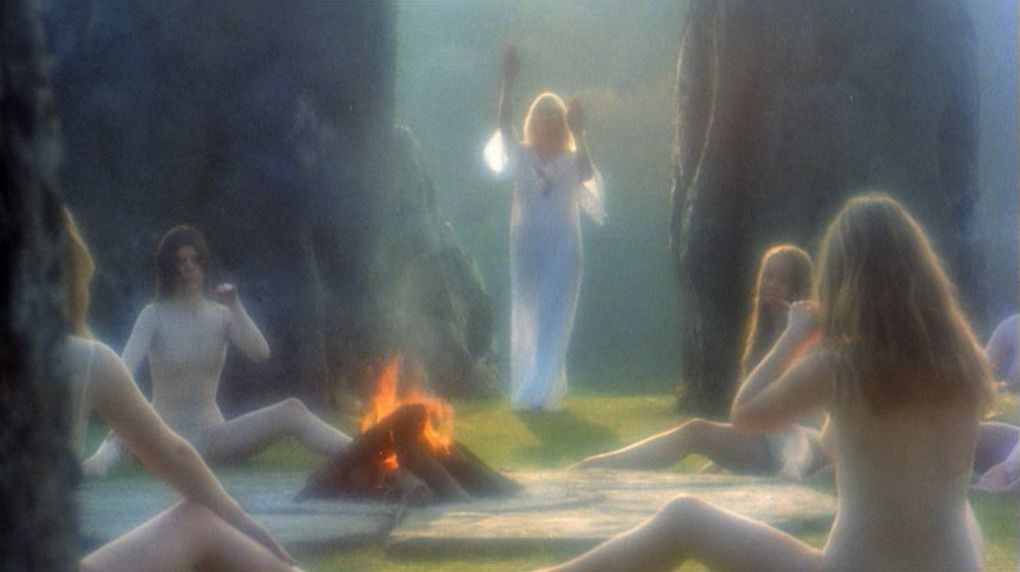
The film's visual language creates a world that feels both achingly beautiful and subtly wrong. Harry Waxman's cinematography captures the Scottish landscape's natural beauty while suggesting something ancient and unknowable lurking beneath the pastoral surface. The May Day festivities, with their colorful costumes and elaborate rituals, feel both joyously celebratory and ominously purposeful. Hardy understands that folk horror works best when the threatening culture appears genuinely appealing rather than obviously sinister.
The musical score, featuring traditional folk songs performed by Paul Giovanni and Magnet, deserves recognition as one of cinema's most effective uses of diegetic music. The songs aren't simply atmospheric—they carry narrative information, reveal character psychology, and create an immersive sense of Summerisle's unique culture. "Willow's Song," "The Landlord's Daughter," and "Corn Rigs" become instruments of psychological warfare, their cheerful melodies and explicit lyrics designed to torment Howie's repressed Christianity.
The film's approach to sexuality is particularly sophisticated for its era, presenting Summerisle's sexual openness neither as utopian liberation nor obvious depravity but as a natural extension of their pagan beliefs. The famous sequence with Willow's seduction attempt becomes a masterclass in psychological horror, as Howie's refusal to succumb feels simultaneously admirable and tragically limiting. The film suggests that Howie's rigid morality, while allowing him to resist temptation, ultimately makes him perfect for sacrifice.
The Wicker Man's treatment of religious themes demonstrates remarkable balance and intelligence, avoiding simplistic condemnation of either Christianity or paganism. The film presents both belief systems as complete worldviews with their own internal logic and moral frameworks, then explores what happens when they collide. Howie's Christianity gives him moral certainty but blinds him to alternative perspectives, while Summerisle's paganism creates community cohesion but requires human sacrifice.
The film's production design creates a world that feels simultaneously familiar and completely alien. Summerisle exists in recognizable Scotland yet operates by rules that feel utterly removed from mainland reality. The May Day decorations, animal masks, and ritual paraphernalia suggest centuries of unbroken tradition, while the modern amenities remind us this isn't some historical curiosity but a living culture existing in contemporary Britain.
Hardy's direction demonstrates remarkable confidence throughout, trusting audiences to engage with material that reveals its true nature slowly and methodically. The film operates as detective story for its first two acts, allowing viewers to share Howie's perspective as he investigates the missing girl. This approach makes the final revelation all the more devastating because we've been complicit in Howie's assumptions about what kind of story we're experiencing.
The film's structure represents perfect narrative architecture, with seemingly innocuous details from earlier sequences acquiring terrible significance in retrospect. The discussion of last year's failed harvest, the animal masks in the school, the May Day preparations—all become pieces of a puzzle that resolves into something far more horrifying than any traditional horror climax.
The famous final sequence represents one of cinema's most devastating conclusions, a scene that works on multiple levels simultaneously. As Howie realizes he's been manipulated from the beginning, that everything he's experienced was designed to prepare him for this moment, his transformation from confident investigator to terrified sacrifice creates genuine emotional devastation. The islanders' cheerful participation in the ritual, treating it as community celebration rather than murder, makes the horror feel more profound than any obvious sadism could achieve.
Woodward's performance during the climax deserves particular recognition for its unflinching commitment to Howie's terror and rage. His recitation of the 23rd Psalm while burning alive doesn't feel like religious platitude but like desperate attempt to maintain identity and meaning in the face of ultimate horror. The final images—the wicker man burning against the sunset, Howie's screams mixing with the islanders' songs—create a conclusion that feels both mythologically resonant and viscerally disturbing.
The Wicker Man's themes of cultural relativism, religious conflict, and the nature of sacrifice feel more relevant than ever in our increasingly polarized world. Hardy and Shaffer created a work that refuses easy answers about whose beliefs deserve respect and whose deserve condemnation, instead presenting a scenario where both sides possess their own terrible logic.
The film's influence on subsequent horror cannot be overstated—it essentially defined what folk horror could be, establishing the rural/urban clash, the investigation structure, and the devastating final revelation as core elements of the subgenre. Yet no subsequent film has matched its particular combination of intelligence, emotional impact, and genuine horror.
The Wicker Man stands as one of horror cinema's most complete achievements, a film that functions perfectly as genre entertainment while operating on deeper levels of cultural criticism and existential inquiry. It's a work that doesn't simply frighten—it challenges fundamental assumptions about morality, belief, and the price of cultural preservation. In a genre too often content with surface-level scares, Hardy created something that burrows deep into the psyche and remains there permanently, a film that proves horror's capacity for genuine artistic and philosophical significance.
This is folk horror's holy text, the unshakeable foundation upon which an entire subgenre was built. Five decades after its creation, The Wicker Man remains unsurpassed and unsurpassable—not because subsequent filmmakers lack talent or vision, but because Hardy and his collaborators achieved something so perfectly calibrated that it exists beyond improvement or replication.